

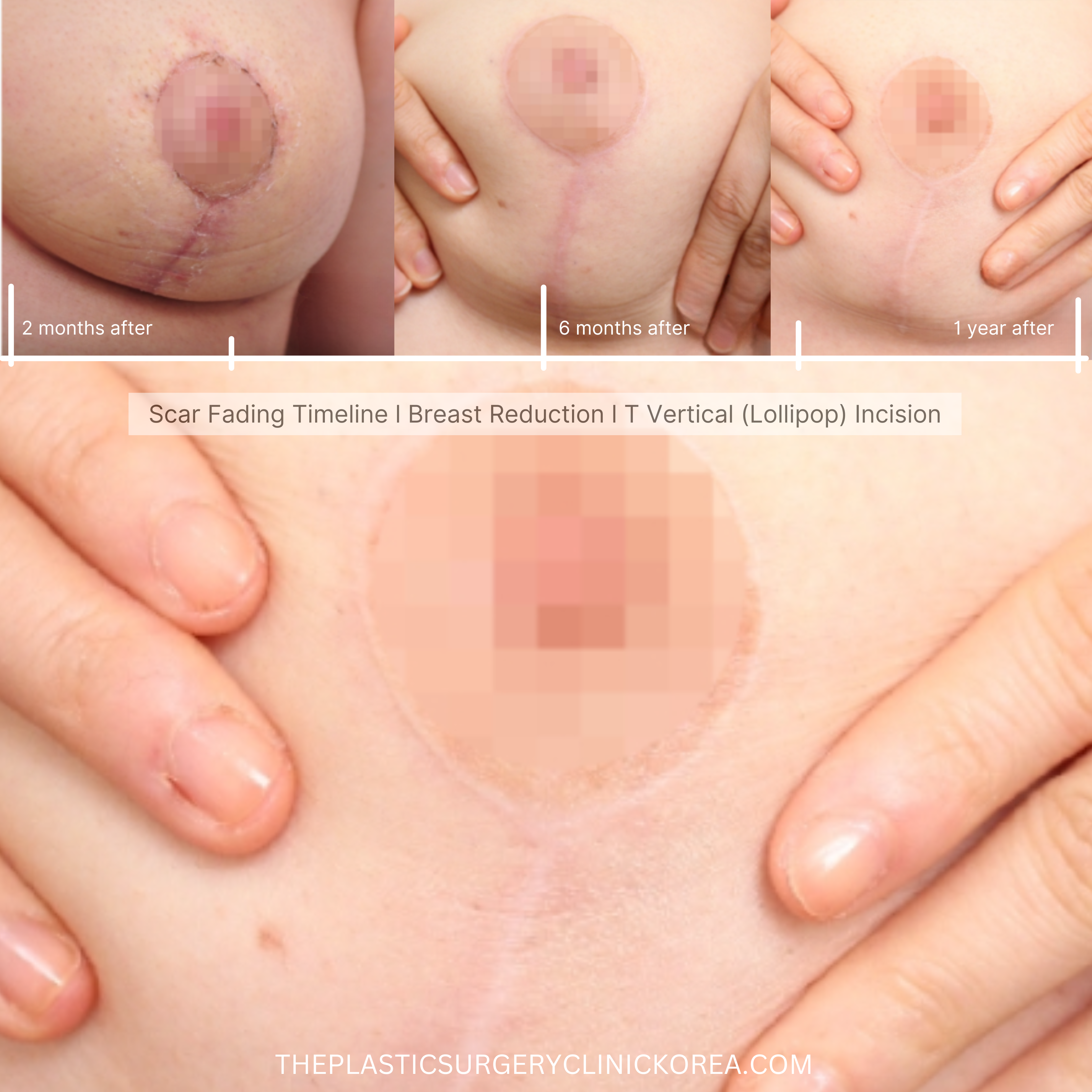
One of the biggest concerns for those considering breast reduction or breast lift surgery is the scarring. To reshape and reduce the size of large, sagging breasts into a more attractive form, scarring is unavoidable. These scars are longer than those from other surgeries, making them a significant obstacle for many.
Today, I would like to introduce three methods to help reduce concerns about scarring in breast reduction surgery. By remembering these three principles, you can alleviate some worries about scarring and reduce stress post-surgery.
1. Short Scars are Better

There are three main incision methods in breast reduction and lift surgery: periareolar incision (donut incision), vertical incision(lollipop incision), and inverted-T incision(Anchor Incision). When comparing the length of scars, the periareolar incision leaves the shortest scar, followed by the vertical incision, with the inverted-T incision leaving the longest scar. Each method has various characteristics that can’t be judged solely by the length of the scar. Choosing the incision method that can achieve your desired breast size and shape is crucial. However, shorter scars are naturally more advantageous if the outcomes are similar.
Many people mistakenly believe that for significantly large or sagging breasts, the vertical incision cannot create beautiful or sufficiently small breasts, and that the inverted-T incision is necessary. Those who have read many of my blog posts will know that beautiful and sufficiently small breasts can indeed be achieved with the vertical incision. The outcome of breast reduction surgery greatly depends on the surgeon’s experience and expertise. With ample experience and know-how in the vertical incision method, one can achieve small, attractive breasts without the long scars of the inverted-T incision.
2. Meticulous Suturing
Suturing is a crucial aspect that determines the quality of the scar. Even if sutures appear similar, the results can vary greatly, so meticulous suturing is essential. I perform both deep and superficial suturing with great care, and for the external sutures, I use Steri-Strips to avoid stitches. This method allows for earlier showering since there are no stitches to remove, leading to more comfortable treatment and clean scars without stitch marks.
3. Detailed Scar Treatment
Scar treatment usually begins one month after surgery. Various lasers are used to treat scars according to their condition, alongside silicone tapes or scar ointments. It is important to select the best treatment method based on the timing and individual scar condition. In addition to laser treatment and scar products, steroid injections, and scar-relieving medications can be prescribed. In some cases, stem cell fat grafting can be performed. Such detailed scar treatment helps make scars less noticeable.

There’s a saying, “If you can’t avoid it, enjoy it.” If you can’t avoid scarring, prepare thoroughly and manage it actively so that you can fully enjoy the results of your surgery later.
If you found this post helpful, please click the like (V) button, and if you have any questions, leave a comment.
This has been Dr. Jaewoo Kim from The Plastic Surgery Clinic.
Please feel free to talk to us for FREE consultation 🙂
